Earrings: Metals, Backs and Everyday Comfort
- Trinket File
- Buying
- 06 Apr, 2026
An earring is chosen in a mirror, in seconds, and then worn for ten hours at a time. The judgement made in the mirror concerns how the piece looks from the front. The parts that decide whether it is comfortable are the post, the back and the total weight, none of which are visible when the earring is worn.
There is a second difference from rings and bracelets. The post sits inside a healed piercing channel, which is a small tunnel of skin in constant contact with metal, warm and slightly moist. That is the most reactive place on the body for a metal sensitivity, and it is where a piece that looks harmless can cause a reaction months after it was first worn.
Gauge and post length
Posts are measured in millimetres of diameter, and the common sizes are around 0.8 mm, 1.0 mm and 1.2 mm. A thicker post spreads the load of a heavy earring and is less likely to cut into the lobe, but it needs a piercing that suits it. A thin post in a heavy earring concentrates the load on a small area of tissue.
Post length matters as much. A post that is too short presses the lobe between the two ends of the earring, which causes tenderness and, over time, can let the back press into the skin. A post that is too long lets the earring hang away from the lobe and catch on hair, collars and headphone cups. Around 8 to 12 mm of post suits most lobes, with the back sitting against the lobe under no more than light contact.
Back types and what each does
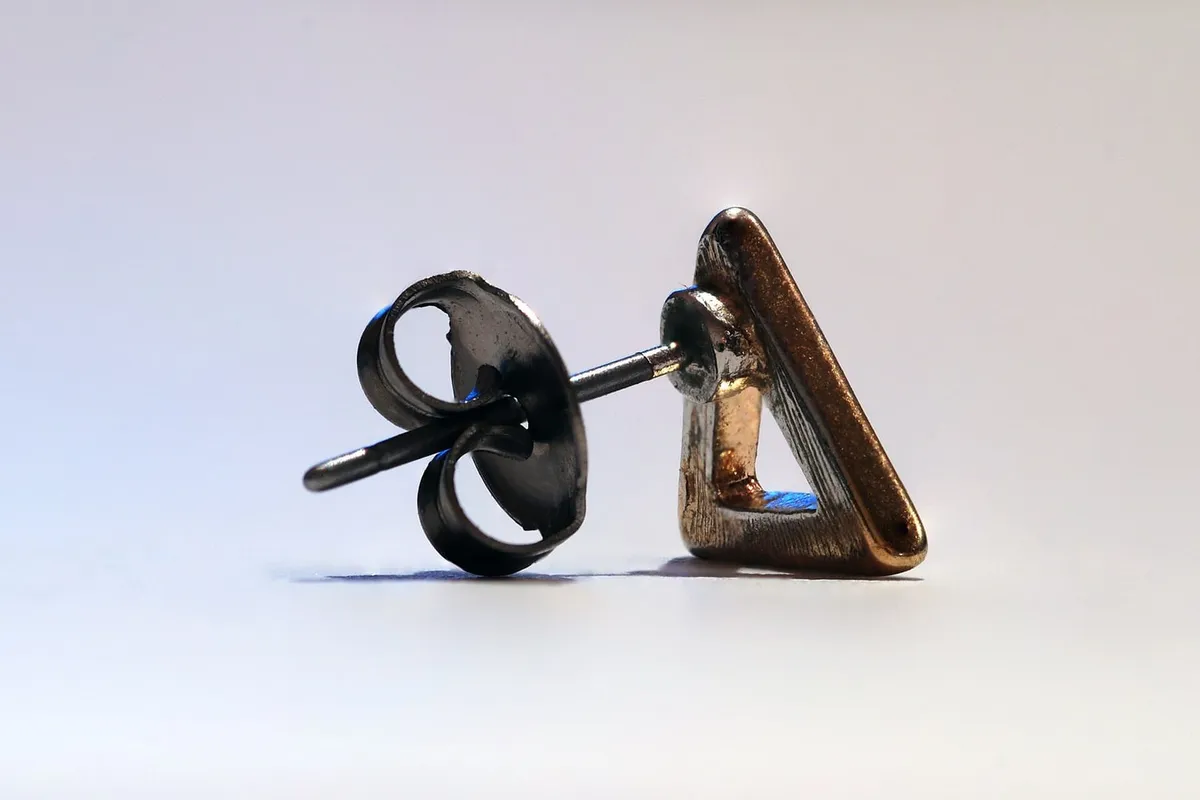
- Butterfly or friction: a coiled metal back that grips the post by friction. Small, cheap and quick, but the grip weakens after repeated fitting as the coils and the post wear against each other.
- Screw back: a threaded post with a screw-on back. It holds positively and is hard to dislodge, at the cost of being slower to put on.
- Bullet or silicone-lined: a back with a rubber or silicone insert that grips the post. It holds better than bare metal when new, though the insert hardens and loses grip over time.
- Lever or hinged back: a hinged lever clamps the post. It gives a definite lock and is common on heavier studs.
- French wire or fishhook, for drops: a curved wire through the lobe. It relies on balance and gravity, so a hook without a stopper slides out during movement.
- Huggies and hinged hoops: a hinged segment with a post that clicks into a notch, with the hoop resting against the lobe. Comfort depends on the inner diameter and the thickness of the section that passes through the piercing.
Whichever type is chosen, the closure should be operated a number of times before buying. A back that grips firmly in the shop is doing so with new springs and an unworn post, and it will be looser after a year.
Metal reactivity and the post
Nickel is the metal most likely to cause a reaction, and it appears in some white gold alloys, in plated base metals and in some stainless steels. Reactions usually show as redness, itching or weeping on the back of the lobe where the metal rests, and they commonly develop after repeated exposure rather than on first wearing. A metal tolerated for years can become a problem later.
The post is not always the same alloy as the visible front of the earring. A gold-coloured front on a plated brass post is a common arrangement, and the post is the part in contact with skin. Asking what the post is made of, rather than what the earring is made of, is the question that matters. Titanium, niobium, platinum and palladium-rich white gold are the usual low-reactivity choices, and 316L stainless steel is widely tolerated though it contains nickel in its composition. Plated pieces are the least predictable, because the coating wears through at the highest-contact points and exposes the alloy beneath.
Discolouration is a separate matter from reactivity. Silver tarnish can leave a dark mark on skin, and copper in an alloy can leave a green one where sweat and metal meet. Neither is harmful, and both are removed with soap and water.
Load, lobe stretch and the faults worth avoiding
Living tissue under a constant load slowly changes shape. A piercing hole is a small opening in soft tissue, and a heavy earring hanging from it extends the hole over months and years. The result is a lobe that has stretched, and in the worst case a split, where the thin wire or post has cut down through the lobe and the earring falls out.
The risk is greatest where a thin post or wire carries a lot of weight, because the pressure is concentrated into a narrow band of tissue. The practical response is to spread the load: a thicker post, a back with a wider contact area, or a piece designed so the weight is supported along the lobe rather than hanging from one point. Rotation helps as well, since the same piercing under the same load every day accumulates the damage.
Sleeping in heavy earrings is the habit that causes most of the trouble, because the load continues while the head is pressed against a pillow. Removing earrings at night is the single most effective measure, and it also protects the earring from bending.
Symmetry and where the earring sits
Piercings are rarely perfectly symmetrical. A pair of earrings that appears to hang differently on each side is often responding to the piercing rather than to a fault in the jewellery, and adjusting the piece to correct a piercing that sits low or forward rarely helps. Two measurements are worth taking before ordering a drop or a hoop: the position of the hole in the lobe, and how much distance there is between the hole and the edge of the lobe.
Hoop size is a question of proportion rather than of style rules. A hoop should clear the lobe edge without pressing on it, and a large hoop on a small lobe will rotate downward and pull. Lobe thickness also varies, and a hinged hoop that fits one person may not close comfortably on a thinner lobe.
A checking routine before buying
- Confirm the post diameter and length suit the healed piercing, not a fresh one.
- Operate the closure twenty times. A back or hinge that feels vague when new will loosen further.
- Ask what the post is made of, since that is the part touching skin.
- Feel the pair in the hand and compare the weight with earrings known to be comfortable for a full day.
- Check that the back rests on the lobe without pressure, and that the earring does not hang away from it.
- Look at where the metal meets the hole, since a narrow wire carrying visible weight will stretch the piercing over time.
- Plan for removal overnight and for rotation between pairs, especially with anything heavy.
Comfort in an earring is mostly arithmetic: weight, the area over which it is carried, and the time it stays on. A lighter piece with a wider post and a firm closure is worn far more often than a heavier one that has to come out after an hour.