Chains, Clasps and How Fastenings Fail
- Trinket File
- Metals and Stones
- 02 Mar, 2026
A necklace that disappears is usually assumed to have been stolen or to have broken in some dramatic way. The common ending is quieter than that. A chain is found tucked inside a collar with every link intact and the clasp still closed, and nothing appears to have failed at all. The loss happened at a small mechanism that opened under a load it was never designed to hold.
Chain construction decides how likely that is. The link pattern sets how a chain behaves under tension and how it wears. The clasp, the jump ring and the two or three links next to the clasp carry the most movement and the least metal, and they are where almost all losses begin.
How a chain holds together
A chain is a sequence of links, and its strength is set by the weakest link and by how each link is closed. There are two families. A soldered link has its joint fused, so the link cannot open without the metal itself failing. An unsoldered link is formed from wire that springs back to shape, and it can be pulled open again by a load above a surprisingly modest threshold.
Most fine jewellery chains are made from drawn wire, and the amount of metal in each link varies widely. A hollow or hollowed link, made from folded sheet rather than solid wire, looks large for its weight and crushes under pressure. That is not always a fault, since hollow links give a heavier visual presence at a lower weight and cost, but the piece should be judged as a light one.
Link types and how each resists wear
- Cable and belcher: oval or round links, one after another, with a visible gap between them. Strong for its weight and easy to repair, but the open links kink and catch on knitwear.
- Curb: flattened links lying in a row, often twisted so the chain sits flat against the neck. It lies neatly and resists tangling, but the flattened section is thin where it bends and is where a curb chain eventually opens.
- Rope: two or more strands interwoven into a twisted pattern. It resists kinking and looks dense, but a single broken strand can unravel a section, which makes repair harder than on a simple chain.
- Box: square links folded and interlocked so the chain holds its shape and does not kink. Each link has a seam and thin walls, so a box chain can split along the seam and it traps dirt and soap in the joints.
- Snake: tightly fitted rings pressed into a smooth tube. It flexes in one plane only, and a bend in the wrong direction produces a kink that cannot be pressed out.
Chains do not stretch in the sense that metal elongates. They stretch because individual links wear thin at their contact points and then deform open. A chain that has grown longer over years has lost metal at every link.
Clasps and how they open
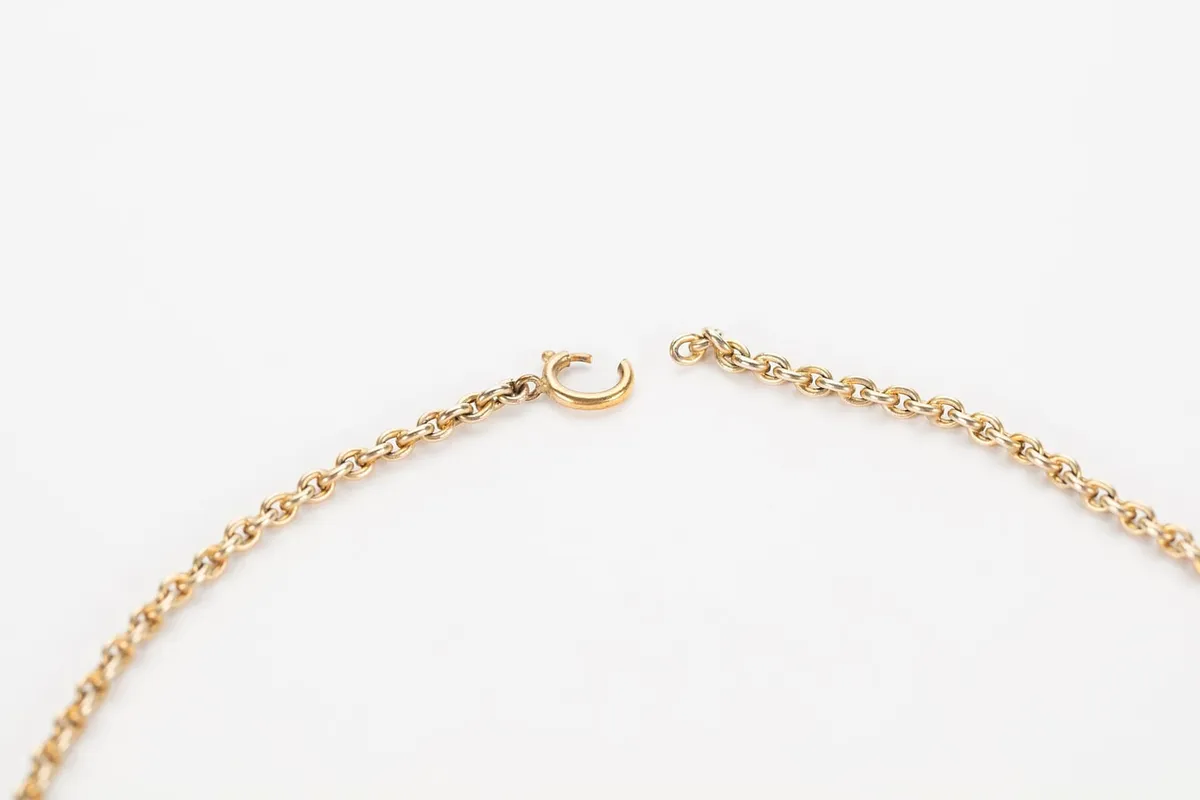
Spring ring clasps are the smallest and cheapest closure. A spring-loaded tongue closes a circular tube, and the spring is a thin leaf or coil that weakens with use. A sideways pull on a spring ring can push the tongue aside, which is why lightweight chains are the ones most often lost.
Lobster clasps use a sprung gate and a lever. They hold better than spring rings and are the sensible default on a chain that will be worn daily. A well-made lobster claw closes with a definite action and the trigger sits flush rather than proud. Hollow stamped versions exist and should be judged by feel rather than by the name.
Box and tongue clasps are flat closures used on bracelets and heavier chains, often with a figure-eight safety catch. The closure itself is positive, but the flat spring inside is a wear point, and the safety catch is what prevents total loss when it fails.
S-hooks and W-hooks have no spring at all. They are traditional on heavy chains and easy to fasten with limited dexterity, and they release under a firm pull by design. A chain with an S-hook needs the hook bent closed, or it will open.
Magnetic clasps are convenient and release under load. A magnetic closure without a secondary catch is not appropriate for a piece that matters.
What actually fails first
- The jump ring at the clasp. An open jump ring straightens under load. Ask for it to be soldered, or choose a chain whose clasp is integral to the end link.
- The end cap or tab. Often crimped rather than soldered, and it pulls off.
- The links adjacent to the clasp. They flex every time the chain is fastened.
- The clasp spring or gate. It wears and stops holding without looking broken.
- The bail or ring where a pendant hangs. It slides back and forth and wears through.
Everyday habits accelerate all of these. Pulling a chain over the head stretches the clasp and the links near it. Removing a necklace by tugging it out of a jumper does the same. A pendant whose weight exceeds what the chain and clasp were built for loads the weakest point continuously rather than occasionally, and the failure arrives sooner.
Matching the chain to what hangs on it
Weight is the practical test. Hold the chain and the pendant together before buying and ask whether the clasp looks adequate to the weight. A chain whose links are thinner than the pendant bail is undersized, and the usual failure is not the chain breaking but the clasp opening.
Two smaller points matter as well. First, the bail should move freely on the chain, since a tight bail wears through the link it sits on. Second, a chain worn with a heavy pendant should not also be the chain used for sleeping.
A routine for buying and for keeping
Before buying, run a short inspection:
- Hold the chain up against a light and look along its length for gaps between links and for bright spots where metal has worn thin.
- Check the clasp through twenty open and close cycles. A lobster claw that feels vague when new will not improve.
- Confirm whether the jump ring is soldered, and ask what the clasp is made of.
- Tug gently at both ends and at the pendant position to see how the chain behaves under light load.
- Look at the links next to the clasp, which should match the rest of the chain in thickness.
Once the piece is in use, a monthly check of the clasp and jump ring takes seconds. Keep chains fastened and laid flat in a pouch or a compartment rather than tangled in a box, since tangling loads the clasp and pulls at links. Worn clasps can be replaced with heavier ones for very little cost, and a soldered jump ring turns a common failure point into a solid one. When a chain does break, the repair is worth doing properly rather than with a squeezed link, because a chain repaired at one weak point tends to fail at the next one along.