Watch Straps and Everyday Accessories: Materials, Fit and Care
- Trinket File
- Accessories
- 15 Sep, 2026
Most advice about watches concerns the movement, which you cannot see and will probably never touch. The strap is the part you feel all day, the part that fails first, and the one you can judge and change yourself. The same reasoning applies to the smaller accessories people wear daily: chains, cufflinks, brooches and buckles. The material and the fittings decide how they behave.
Measuring a strap before you buy
Three numbers matter, and getting the first one wrong makes a strap unusable.
Lug width. The distance in millimetres between the two lugs, measured across the inside of the case where the strap fits. It is often written on the case back or the specification sheet; if not, measure it with a ruler or a set of callipers. Straps come in standard widths, so a case whose lug measurement falls between two standard sizes will need the next size down, leaving a small gap at the lugs.
Thickness against the case gap. A thick, padded strap can rub against the case, or prevent the strap from turning down cleanly. Vintage and slim cases usually suit thinner straps.
Curved or straight ends. Some cases are cut so that a straight-ended strap leaves the strap standing off the case. Curved ends look tidier but must match the case curve, which makes them model-specific.
Spring bars, and why they deserve attention
The spring bar holds everything together, and a bent or worn bar is the most common reason a watch ends up on the floor. Standard bars have a small, thin shoulder between the lug and the strap; quick-release bars have a built-in lever so the strap can be changed without tools; some cases use thicker or drilled-lug bars.
Check three things when changing a strap: that the bars are straight and even in length, that the lug holes are not wallowed out (a worn hole lets a bar slip out sideways), and that the strap is not pressing on the bar’s shoulder, which can push it out. When you finish, tug the strap gently in both directions before wearing the watch anywhere hard-floored.
Strap materials and what they tolerate
Leather — calf, buffalo, cordovan, and the more exotic skins — looks best when new and is the least tolerant of moisture and sweat. Leather absorbs water, darkens, stiffens and eventually cracks, and salt from sweat is hard on it. It should never be submerged, and a leather strap on a water-resistant watch is still not a swimming watch. Let it dry at room temperature if it gets wet, never on a radiator or with a hair dryer, and rotate between two straps so each has time to dry out.
Rubber and silicone are the practical choice for water, sweat and heavy use. They do not absorb water, they clean easily, and they tolerate chlorine better than leather, though not indefinitely. Watch for UV hardening and for lint, which silicone attracts more than any other material.
Nylon, canvas and so-called NATO straps pass under the case, so if one spring bar fails the watch is still held by the other — a genuine safety advantage in water. The trade-off is bulk: a thick single-pass strap lifts the watchhead off the wrist and can trap water.
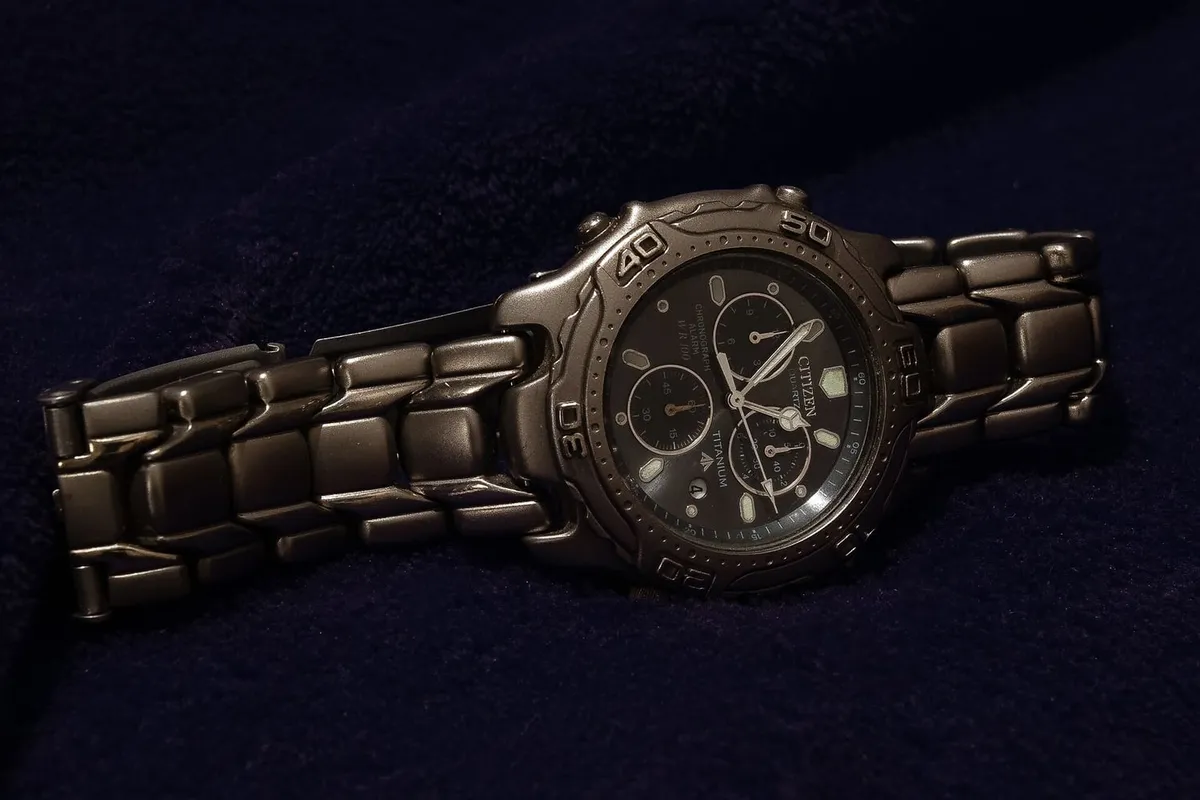
Steel bracelets are durable but not maintenance-free. Sizing usually means removing links, by pin-and-collar or screws, both of which need the right tool and, for screws, a touch of thread-locking compound. Micro-adjustment in the clasp saves a bracelet that fits well in winter and too tightly in summer, and over years bracelets stretch as pins and holes wear.
Mesh and Milanese bracelets adjust continuously through a sliding clasp, which makes them easy to fit but prone to snagging on knitwear. If the clasp is magnetic, check that it cannot release under a knock.
Fit
A watch should sit on the flat of the wrist without sliding over the wrist bone, and without leaving an indentation. The usual target is enough room to slide a finger under the clasp area without the watch rotating freely.
Two common mistakes: wearing it too tight, which strains the clasp and kinks a leather strap at one point, and wearing it too loose, which lets the case slide and knock. A leather strap that is tight when new usually becomes right after a week or two; one that is uncomfortable when new is likely to stay that way, and forcing it only shortens its life. Deployment (folding) clasps change where the watch sits and spread the wear of opening and closing over a mechanism rather than the strap, which is usually kinder to leather at the cost of a bulkier underside.
Water, and why the strap is the weak point
Water resistance ratings refer to the case, and they describe static pressure in a laboratory rather than the moving pressure of swimming or diving. They also depend on gaskets that age, so a watch rated for swimming may still leak if it has never been serviced or if the case has been opened recently without replacing the seals.
For anyone wearing a watch near water, two habits help. Have a watchmaker pressure-test it after the case has been opened, whether for a battery or a service. And avoid hot showers and saunas, which cycle the seals through temperature changes they were not designed for, as well as operating the crown or pushers underwater.
Since the strap cannot be protected by the case, treat straps separately: leather off for water, rubber and nylon for anything wet.
Care and storage
Rinse rubber, nylon and steel with fresh water after swimming or heavy sweating, then dry them. Clean leather rarely and gently: a barely damp cloth, then a little conditioner if the maker recommends it, applied sparingly. Never soak a leather strap.
Store watches with the strap relaxed and unclasped where possible, so the leather is not stretched over the buckle for months on end, and keep them out of direct sun; UV dries leather and fades rubber.
The same principles for other accessories
Small accessories are constructed like jewellery and fail in the same places.
Cufflinks have a joint and a mechanism — a swivel post or a fixed post. Operate them a few times before buying, and check that the toggle sits flat once closed. Plated cufflinks show wear around the toggle and on the edges of the face.
Chains, pendants, brooches and badges follow the rules in our construction guide: check the clasp, the jump ring and the pin catch, and keep the weight of what hangs on a chain within what the chain and its clasp can hold. Bag and belt fittings deserve the same look — a buckle plate or rivet cutting into the leather every time it fastens will wear through it.
When to use a professional
A watchmaker is the right person for pressure testing, resealing, bracelet resizing with pin-and-collar systems, and anything involving the movement. A jeweller or leatherworker can repair a strap, replace a buckle or re-stitch a keeper. A good test of a workshop is whether it can tell you what will happen to the strap or case while the work is done; if the answer is vague, ask elsewhere.