Ring Sizing and Fit: Getting It Right First Time
- Trinket File
- Buying
- 02 Feb, 2026
A ring size is treated as a fixed property of a finger, like a shoe size with a number attached. Fingers do not hold a size. They swell in heat and after exertion, thin in the cold, and change over years with weight, age and the seasons. A number taken once, at whatever hour it happened to be, is a snapshot of a moving target.
The second half of the problem is that two rings of the same internal diameter can feel entirely different on the same finger. Width, profile and the number of bands stacked together change how much skin the metal touches and how easily the band passes a knuckle. A sizing chart describes a circle. It does not describe a fit.
When to measure a finger
Finger volume follows body temperature, and body temperature follows the day. Fingers are smallest in the early morning and largest in the late afternoon and evening, and the difference between the two can amount to most of a size. Measure in the evening, indoors, with the hands at normal temperature, and never straight after a cold walk, a swim or heavy physical work.
Weather does the same thing over longer periods. A ring bought in a cold January can feel tight in July, and one fitted during a heatwave can turn loose by winter. Travel shifts fluid balance as well. Where a measurement falls between two sizes, take it again on three or four separate days before ordering anything.
Salt, alcohol and some medications increase swelling, and so does pregnancy. Hands also change with age: the joints enlarge while the fleshy base of the finger thins, which is the mechanism behind rings that once fitted and now rotate freely.
The base of the finger, not the knuckle
A ring must clear the knuckle on the way on and then sit at the base of the finger, and those two measurements rarely agree. Where the knuckle is noticeably wider than the base, a band sized to the base will not pass the joint, and a band sized to the knuckle will sit loose and spin. The practical compromise is a band that passes the knuckle with slight resistance and then settles at the base without pinching.
Fingers differ across the hand too. The middle finger is usually the largest and the little finger the smallest, and the dominant hand tends to be slightly larger than the other. A measurement taken on one hand and applied to the other is often half a size out, which is why a pair of rings bought from a single number rarely both fit.
Width and profile change everything
Width is the variable most often left out of a sizing chart, and it matters as much as diameter.
- Narrow bands, 2 mm and under: contact a small strip of skin and slip over a knuckle easily, so they tend to feel loose for their stated size.
- Wide bands, 6 mm and over: spread load across more of the finger and grip more firmly, so they feel tighter at the same internal diameter.
- Comfort fit, also called court: rounded on the inside, so the band meets the finger at its centre and clears the knuckle more readily. A comfort-fit ring is often ordered half a size smaller than a flat one.
- Flat and D-shape profiles: a flatter inner face sits on more skin, feels firmer and resists rotation.
As a working estimate, a band of about 6 mm or more feels around half a size tighter than a 2 to 3 mm band of the same measured diameter. Published fitters’ allowances vary, so the reliable method is to have the measurement taken with a gauge of the same width and profile as the ring being ordered. For a band ordered remotely, giving the maker the intended width matters more than giving a size number on its own.
Stacks and multiple rings
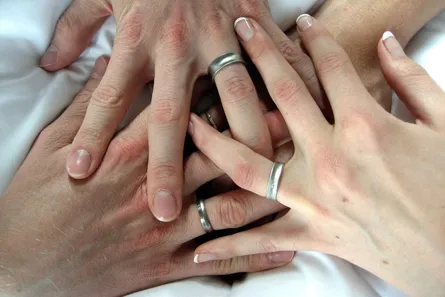
Each ring added to a finger adds width and load. Three 2 mm bands worn together behave like a single 6 mm band, which is why a stack assembled from rings that fit well individually often feels tight as a set. Size the stack as one object, with all the bands in place, rather than sizing each ring alone.
Bands worn against each other also abrade each other. The shared contact points lose a little metal over years, and a set of thin rings worn tight will wear faster than the same rings worn singly. A small amount of movement between them is preferable to constant pressure.
Half sizes and the space between
Half sizes cover most of the practical range, and some ranges offer quarter sizes. When a measurement falls between two, the choice depends on the band: take the larger for a wide band, a comfort-fit profile or a stack, and the smaller for a very narrow band or a finger where the band sits above the knuckle.
Two failure states are worth recognising before buying. A band that can be shaken off over the knuckle will eventually be lost, however firm it feels when pushed on. A band that leaves a deep mark and is difficult to slide off during the warmest part of the day is too tight. A ring that will not come off should be dealt with by a jeweller, or by a medical professional if the finger is swollen or painful, rather than by pulling harder.
What resizing does to a band
Resizing a plain band means cutting the shank, adding or removing a section, and welding the ends back together. On a plain polished band a competent bench jeweller can make the joint almost invisible. On a textured, engraved, milgrained, twisted or hammered band the pattern at the joint will not match, and on a band with stones set the whole way round the work cannot be done without resetting stones.
Materials set limits too. Titanium, tungsten carbide, ceramic and some pattern-welded metals cannot be resized by conventional means. Repeated sizing thins a shank or leaves solder lines that can later crack, so two or three resizes across a lifetime is a reasonable working limit for a plain band. Beyond that the proportions of the band begin to change visibly, and a replacement is often the more honest option.
The checking routine
Before committing to a size on a band that will be worn daily:
- Measure at the end of the day, indoors, with the hands at normal temperature.
- Ask for a gauge that matches the width and profile of the intended band.
- Take the measurement on the hand and finger that will wear the ring.
- Check that the band clears the knuckle with light resistance and sits at the base without pinching.
- Test removal in the late afternoon or evening, when the finger is at its largest.
- Size a stack for its combined width rather than for one band.
- Ask what can be changed later, since a material that cannot be resized changes the value of getting it right first time.
The measurement is the simple part. A band that fits the correct hand, taken at the right hour and matched to its width and profile, is the one that gets worn every day instead of living in a drawer.